 HugeCrypt
HugeCrypt
HugeCrypt
HugeCrypt locks your secrets inside an encrypted genomic file generated from 24 billion human DNA loci — a vault that's meaningless without your PIN.
Biological Entropy
HugeCrypt derives its cryptographic strength from the human genome — not random number generators, not mathematical primes, but 3 billion years of biological evolution.
* Live and ad hoc pattern inference on normal server load.
** HugeCrypt guarantees reproducible decryption at 70 chars, use with caution.
Pipeline
HugeCrypt follows a deterministic but genomically irreversible transformation pipeline. No two runs produce the same key, and the path cannot be retraced without the encryption file and/or your PIN.
The engine randomly samples chromosomal identifiers, strand orientations, and start–end coordinates across multiple human genome assemblies, building a cross-assembly genomic keyring. Each coordinate set is unique, non-repeating, and structurally diverse.
The genomic coordinates are resolved into real DNA sequences through a high-throughput reconstruction pipeline, producing a heterogeneous corpus of nucleotide strings — typically thousands to millions of bases — that cannot be recognized or decoded by conventional genomic tools.
A machine learning framework trained on the reconstructed sequences extracts latent relational patterns using a feature-expansion encoding strategy. This step is designed to be non-reducible to frequency-based signatures, making the transformation pipeline effectively irreversible.
Vector embeddings from the AI model are mapped onto a kmer dictionary. Angular derivatives and embedding scores are consumed to produce a unique cryptographic sequence — your password or encryption key — at the exact character length you specify.
Your secret is stored back inside the genomic coordinates — not in plain text, not in a conventional cipher, but encoded within the same biological structure that generated it. The resulting file is an expansive 200 KB ciphertext vault. Only HugeCrypt with the correct PIN can reconstruct the original value.
Features
A sticky note. A spreadsheet. A photo on your phone. Every one of those is a naked password waiting to be seen. HugeCrypt replaces all of that with an encrypted genomic file that looks like scientific noise to anyone without your PIN.
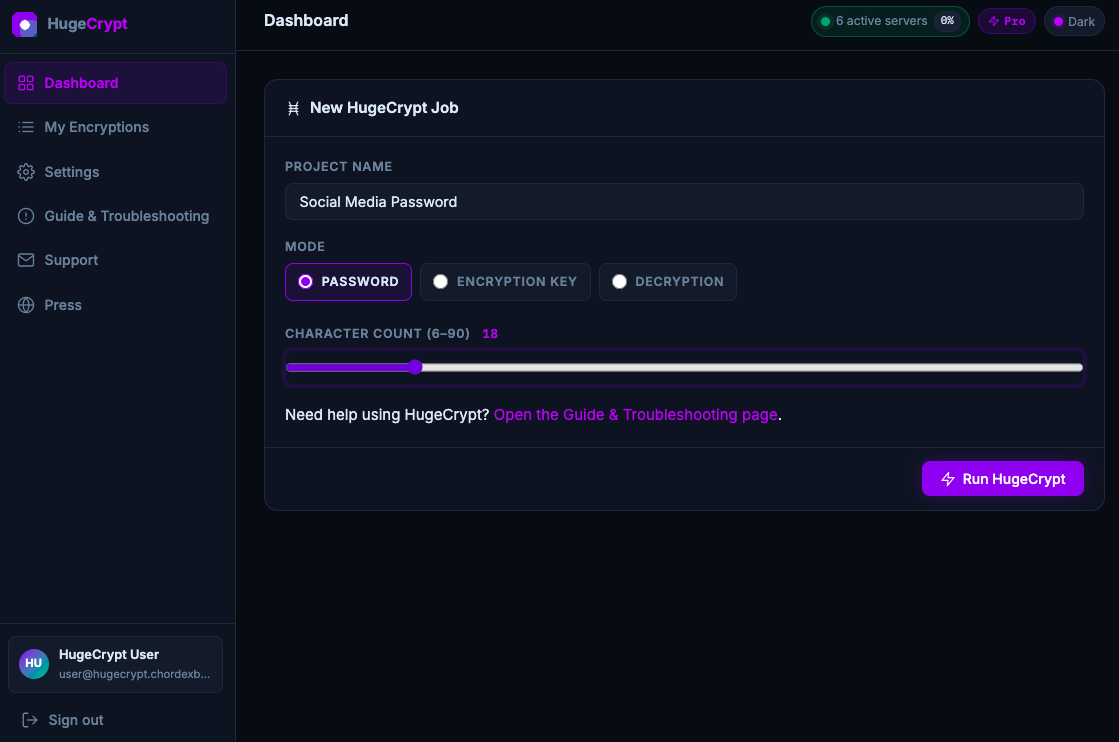
Choose Password mode (alphanumeric + symbols) or Encryption mode (alphanumeric only), set a length between 6 and 90 characters, and let the genome do the rest. No user-chosen words, no patterns, no guessable sequences.
Every run produces a compact 200 KB vault file. Store it anywhere — your desktop, a USB drive, a cloud folder. It's meaningless without HugeCrypt and your PIN, so storage location doesn't matter. Your raw password never touches the file.
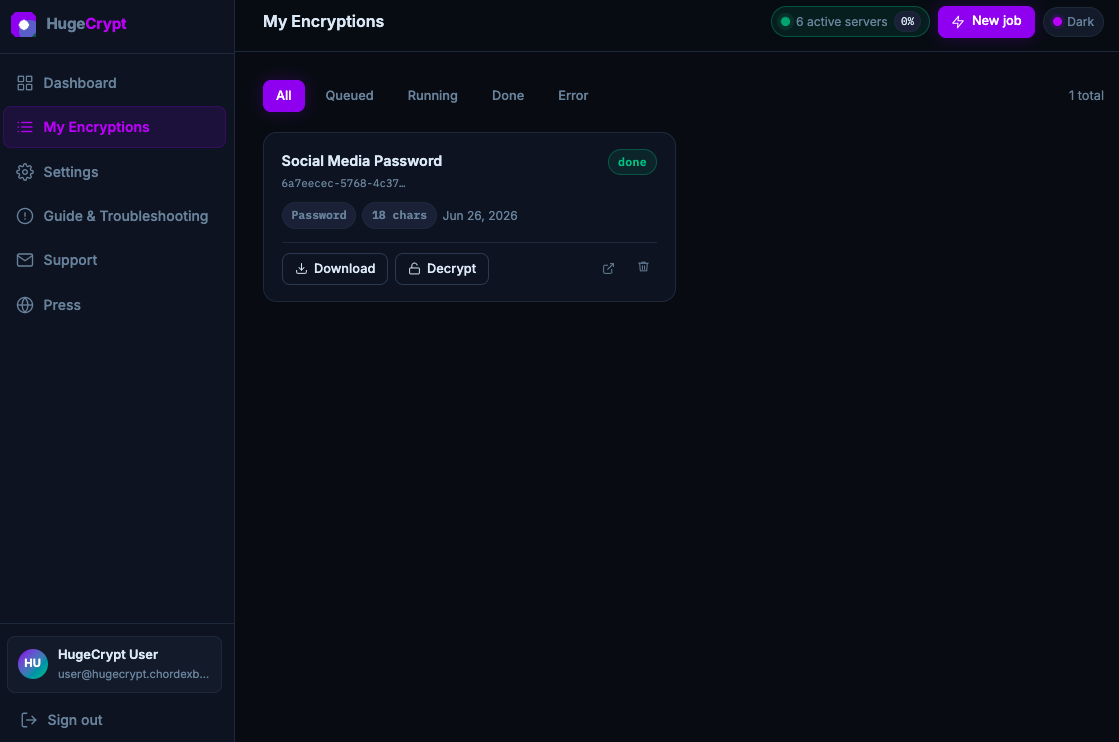
Need your key back? Load the vault file, enter your PIN, and HugeCrypt reconstructs the original value from the genomic record. No cloud sync required, no subscription to a password cloud — your file is your vault.
Use a HugeCrypt-generated key as your login token instead of a typed password. The key is derived from genomic entropy, making it brute-force-resistant and different from every other key you hold.
If a key is compromised or you want a fresh corpus, generate a custom kmer dictionary – now replaced by PIN codes. This recycles the same encryption data but produces a distinct output sequence — effectively rotating your key without starting from scratch.
Transform a meaningful passphrase into a genome-encoded token. Store the token, discard the phrase. Recover the original phrase later by decrypting — your memory isn't the weakest link anymore.
Your data, exclusively yours
HugeCrypt does not collect and store your data for training the cipher. By design, HugeCrypt only acts on genomic data that's already been publicly available.
Architectural Paradigm Shift
Traditional software relies on locking raw keys inside cloud databases. HugeCrypt fundamentally departs from storage dependencies, translating physical biology into dynamically extracted secrets.
| Security Parameter | Standard Vault Architecture | HugeCrypt Ecosystem |
|---|---|---|
| Core Operational Model | Zero-Knowledge Storage Stores raw plaintext assets inside a static database container protected by standard ciphers. |
Zero-Trust Generation Does not store raw strings anywhere. Reconstructs secrets dynamically via genomic coordinate lookups. |
| Primary Target Vulnerability | High Risk Honeypots. Centralized provider databases and single master-password configurations represent single-point failure nodes. | Near-Zero Attack Surface. Fragmented 200 KB coordinate maps contain no clear text strings and represent raw noise to attackers. |
| Entropy Foundation | Pseudo-Random Number Generators (PRNGs) constrained by predictable algebraic math boundaries. | Biological Chaos. Grounded in 3 billion years of human evolution, providing an expansive (~51K+ bits) baseline space. |
| Cryptographic Paradigm | Vulnerable to mathematical reverse-engineering threats and eventual scaling capabilities of quantum compute arrays. | Future-Proof. Employs non-reducible machine learning feature expansions paired with alphanumeric k-mer mapping frameworks. |
App interface
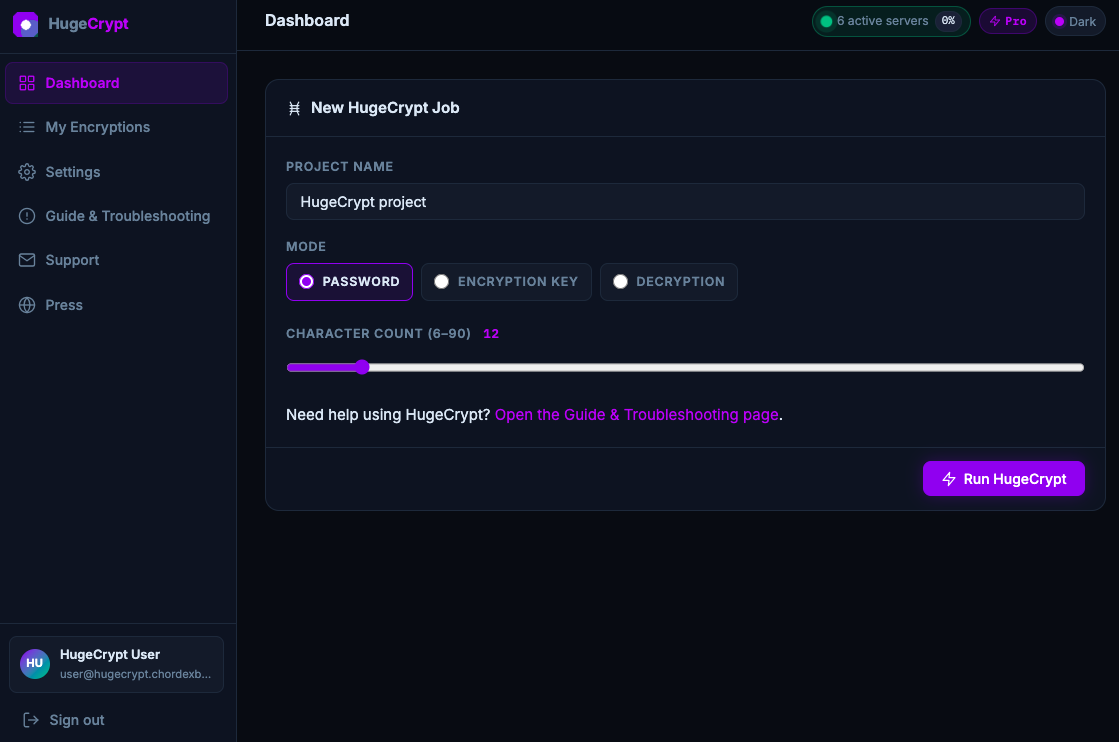
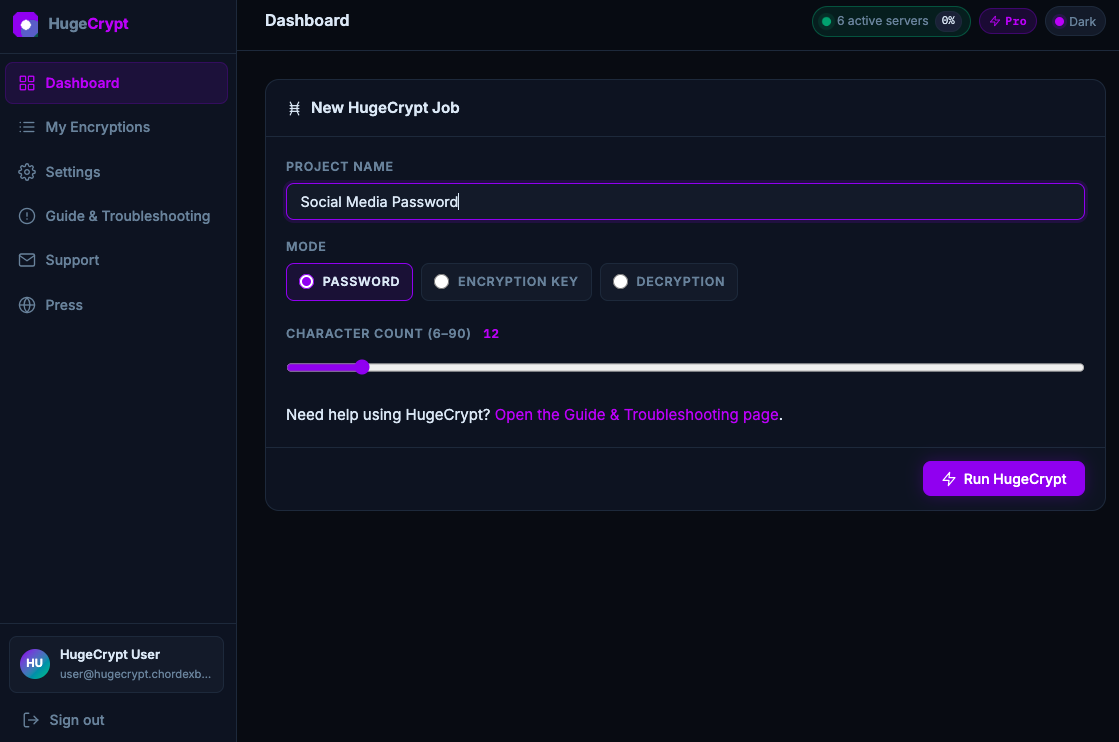
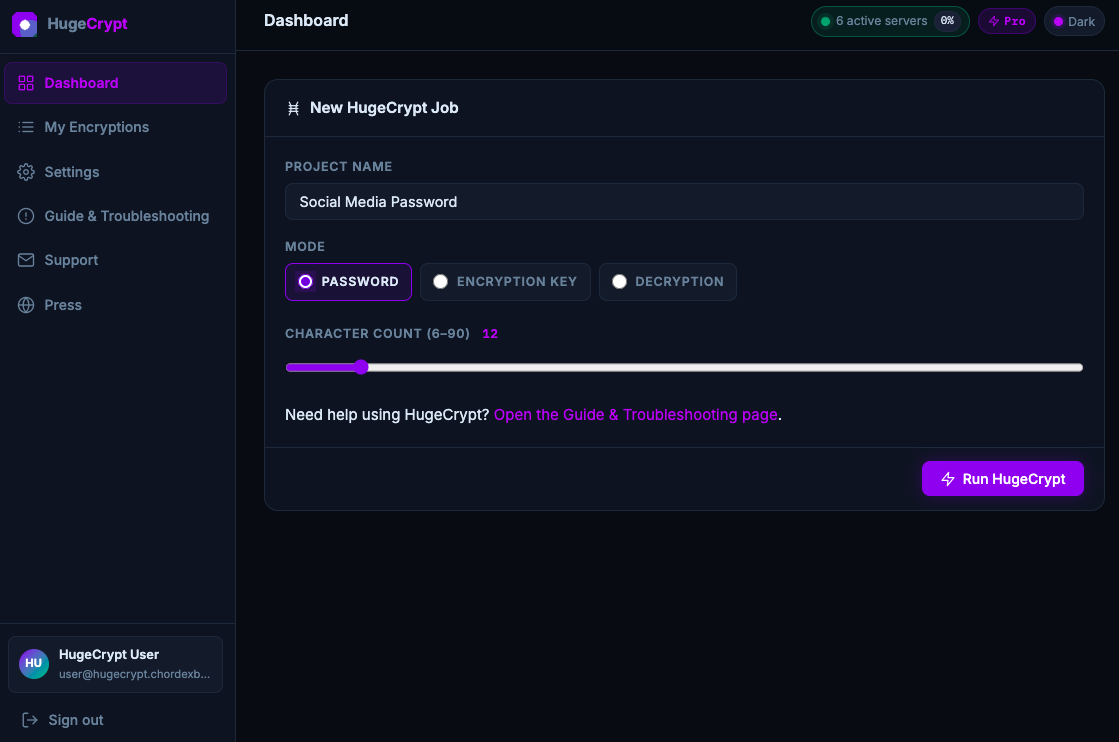
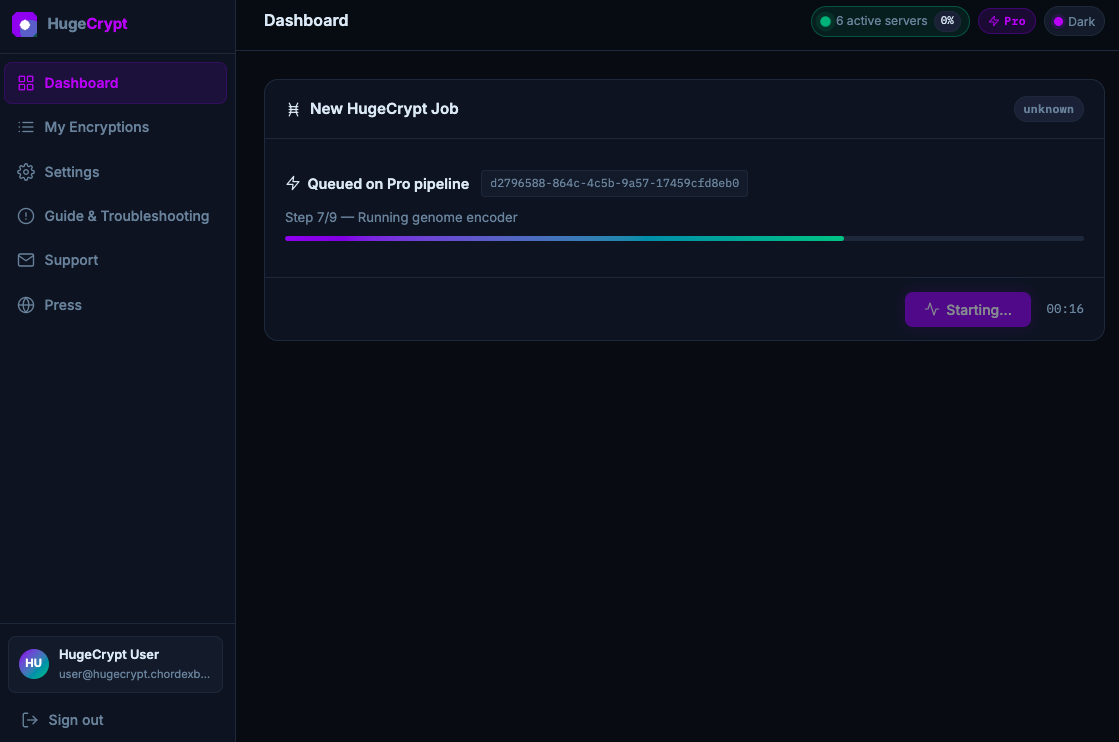
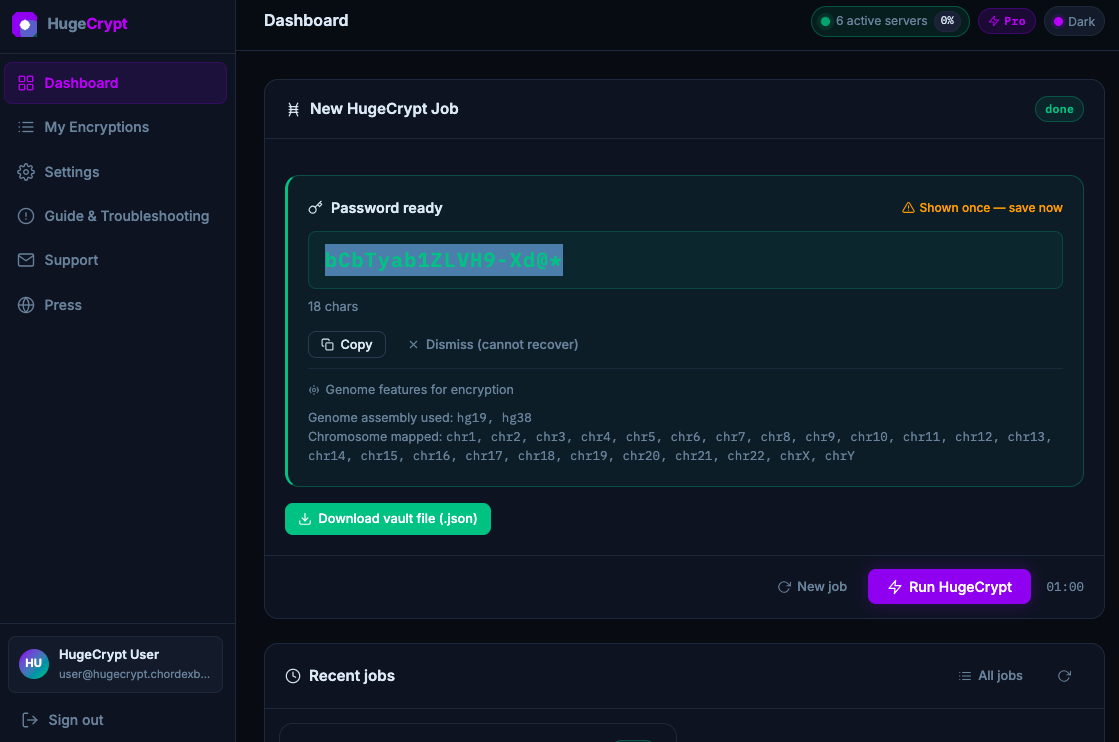
HugeCrypt works like an authenticator app — generate, save, decrypt. The genome complexity is running in the background so you don't have to think about it.
Added security
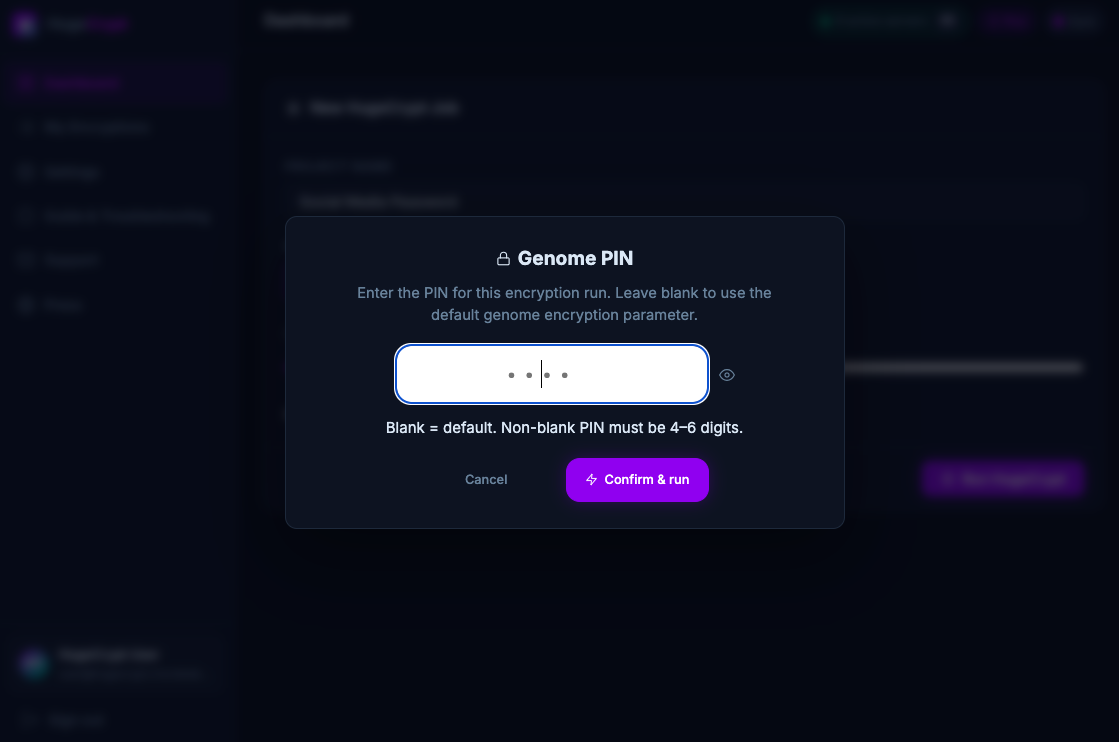
Even if an attacker gets hold of your vault file and runs it through HugeCrypt, they cannot recover your secret without the correct PIN. The file is bait; the PIN is the lock.
HugeCrypt requires your PIN to reconstruct the original value. Without it, the genomic coordinates return noise.
The vault is built from real genomic coordinates, making it computationally impractical to synthetically reproduce or reverse-engineer without the source genome and the original run parameters.
You need both the vault file and the PIN. Losing one means the attacker has nothing. This is the same logic as hardware security keys, applied to genomic cryptography.
The AI model's feature-expansion step is designed to be non-reversible to frequency-based signatures. There is no algebraic inverse, no lookup table, no brute-force shortcut.
HugeCrypt shows your generated key once at output time. After dismissal, only the encrypted genomic vault remains. The plaintext version is gone — by design.
Deploy HugeCrypt for your system
HugeCrypt is available for institutional partnerships, pilot deployments, and experimental or developmental pipelines where teams want to explore genome-inspired cryptography for their own systems. The platform is designed to generate cryptographic outputs from genomic sequence structures — not from your institutional or user data.
We welcome collaborations with research groups, universities, startups, laboratories, and technology teams interested in testing HugeCrypt as a security layer, key-generation engine, passwordless authentication component, or genomic vault framework.
Science legacy
HugeCrypt is the production-ready web application built on top of DNAcrypt-AI — a cryptographic framework that uses human genome vocabulary, machine learning sequence intelligence, and kmer-based encoding to generate provably high-entropy cryptographic artifacts.
The underlying protocols are published on protocols.io, the architecture is publicly available on GitHub, and the research snapshot is released on Research Square. DNAcrypt-AI is not a black box — it is a documented, reproducible pipeline you can inspect, cite, and build upon.
Read the manuscript → View GitHub repository →Get in touch
Send us a message and we'll get back to you at hugecrypt@chordexbio.com.
Generate your first HugeCrypt key for FREE.